European Conference on Embolotherapy
ET countries
GENERAL - ET 2026

June 17-20 | Valencia, Spain

Mastering embolization

June 17-20 | Valencia, Spain

Mastering embolization

June 17-20 | Valencia, Spain

Mastering embolization

June 17-20 | Valencia, Spain

June 17-20 | Valencia, Spain

ProgrammeShoulder embolization

Shoulder embolization


Three things you will learn at my lecture

1. The arterial anatomy of the shoulder presents significant challenges. A thorough understanding of this anatomy is essential for safe and effective embolization procedures.

2. A multidisciplinary team approach is essential, and each patient must be treated on an individualized basis. The best patients to start with are those with adhesive capsulitis presenting with pain and limited mobility for less than one year of evolution and who are refractory to other therapies.

3. Angiography and embolization can be the first step to treat other overlapping causes such as rotator cuff tear or calcific tendinitis.

Dr. Ana Fernández Martínez
Speaker bio
 

Musculoskeletal embolization (MSKE) is an emerging image-guided technique increasingly recognized for its role in managing chronic pain syndromes related to benign musculoskeletal disorders. By selectively occluding abnormal neovessels associated with chronic inflammation, MSKE aims to reduce pain and the need for pharmacological treatment over a long period of time, improve function and minimize the need for more invasive procedures [1–3].

Indications for MSKE include osteoarthritis-related pain, shoulder adhesive capsulitis (AC), chronic tendinopathies, sports injuries such as lateral epicondylitis or jumper’s knee and refractory hemarthrosis [4–8]. These conditions often involve pathological hypervascularization, which can be effectively targeted using embolic agents[9].

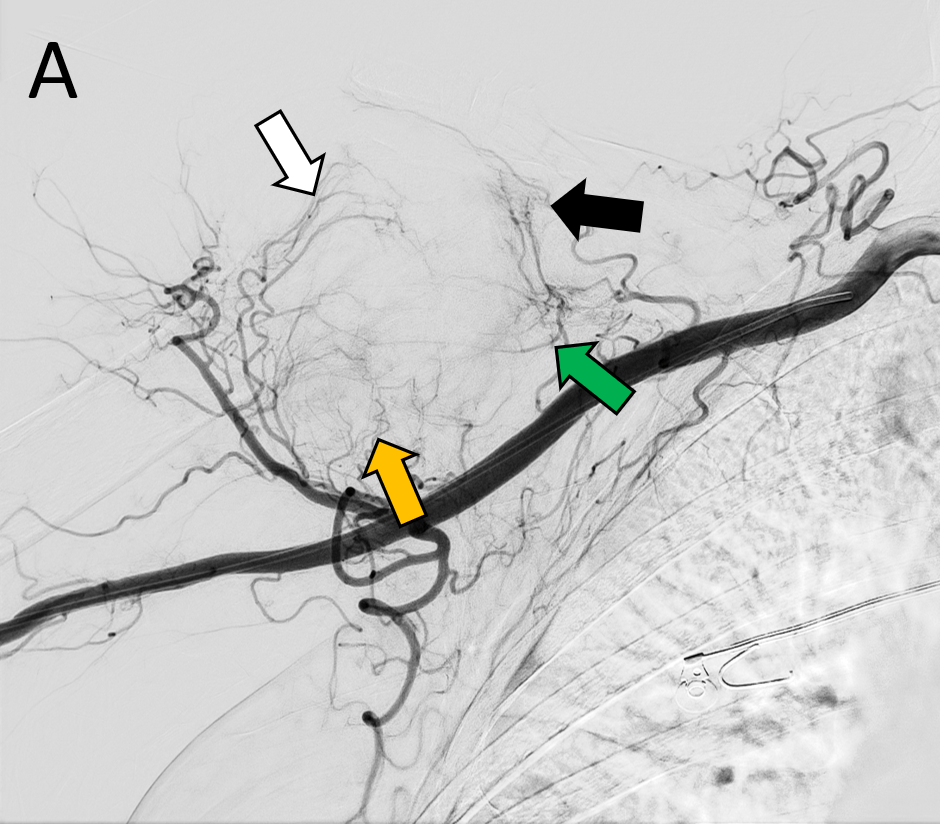
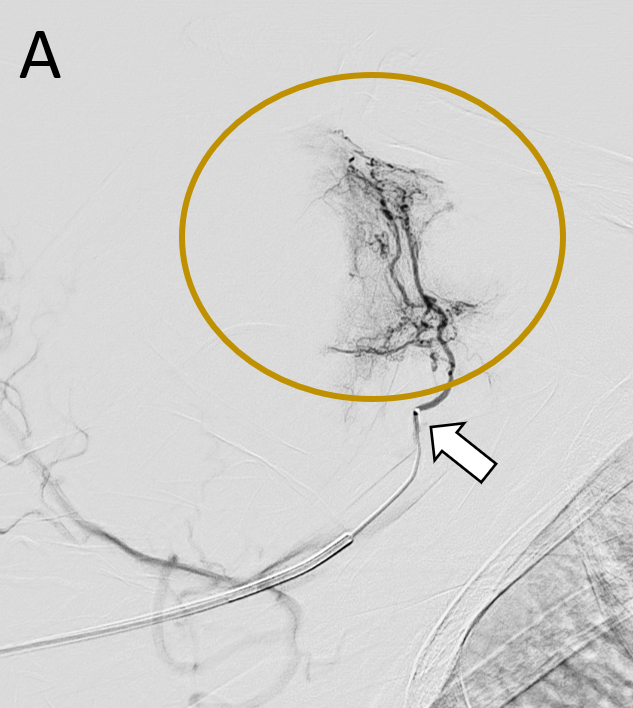
The procedure is typically performed on an outpatient basis, with a low complication rate and minimal recovery time. An arteriography of the upper or lower limb is performed depending on the joint to be treated. A 3F to 6F catheter is usually employed and the use of small microcatheters, from 1.7F to 1.9F, is recommended. The target of the embolization is the disappearance of the hypervascularized areas called “blush areas” (Figures 1 and 2), for which different types of materials, spheres, imipenem/cilastatin or lipiodol mixed with contrast can be used as embolic agents [10–12].

Recent clinical studies have demonstrated promising outcomes, with significant pain reduction and functional improvement in AC reported in the majority of patients [13,14]. While long-term data are still being collected, current evidence supports MSKE as a safe and effective adjunct or alternative to surgery in selected patients. Multidisciplinary collaboration, especially with orthopedic and pain specialists, is crucial to identify appropriate candidates, ensure comprehensive and follow-up [10].

Musculoskeletal embolization represents a significant advancement in the non-surgical treatment of chronic pain, offering targeted relief and improved quality of life for patients. As the field evolves, interventional radiologists have a unique opportunity to offer targeted, minimally invasive solutions for patients suffering from chronic musculoskeletal pain.


Figure 1. A. Patient with adhesive capsulitis. Angiography of the right shoulder showing diffuse capsular enhancement at the axillary recess (yellow arrow), at the rotator interval (green arrow), at the superior capsule (black arrow) and in the intertubercular groove (white arrow). B. Disappearance of the areas of hypervascularization after the embolization.

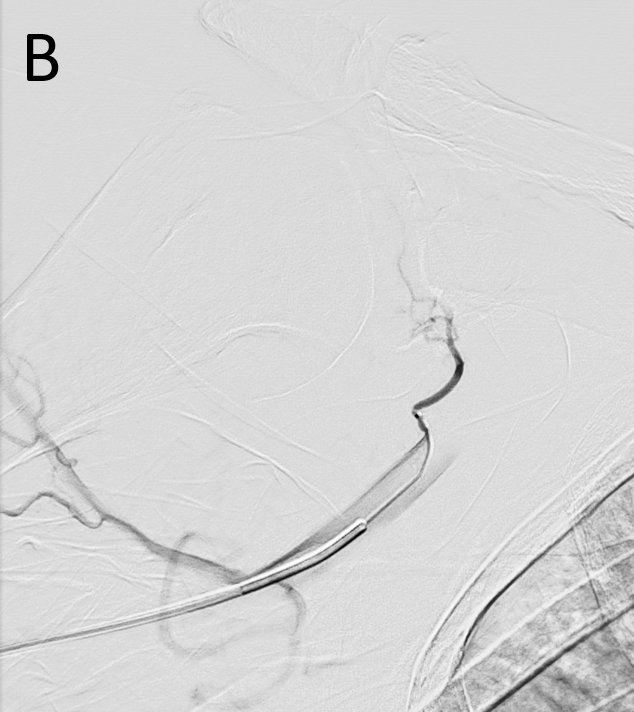
Figure 2. A. Super-selective angiography with the microcatheter from the coracoid artery (white arrow). Blush enhancement of the rotator interval (circle). B. The final angiography confirms the patency of the coracoid artery and the disappearance of the initial arterial blush.

Ana Fernández Martínez

University Hospital of León/ES and San Juan de Dios Hospital/ES

Dr. Ana Fernández Martínez, MD, PhD, EBIR, EDNI, has been an interventional radiologist at the University Hospital of León, Spain since 2015, when she completed her residency there. She is also the Head of the Musculoskeletal Interventional Unit at San Juan de Dios Hospital, León, Spain since 2025. She presented her doctoral thesis, entitled “Safety and clinical results in arterial embolization of primary and secondary stiff shoulder,” in 2021 and received a summa cum laude distinction from the University of León. In her daily work, she performs clinical consultations and musculoskeletal embolization, vascular access procedures, urgent vascular and oncological pathologies, non-vascular pathologies, and manages ischaemic stroke on an on-call basis.
 

References

  1. Epelboym Y, Lee L, Okuno Y, Korchi A. Genicular artery embolization as a treatment for refractory osteoarthritis related knee pain. Skeletal Radiol [Internet]. Skeletal Radiol; 2022 [cited 2023 Jan 9]; Available from: https://pubmed.ncbi.nlm.nih.gov/36269332/
  2. Iwamoto W, Okuno Y, Matsumura N, Kaneko T, Ikegami H. Transcatheter arterial embolization of abnormal vessels as a treatment for lateral epicondylitis refractory to conservative treatment: a pilot study with a 2-year follow-up. J shoulder Elb Surg. 2017;26:1335–41.
  3. Okuno Y, Matsumura N, Oguro S. Transcatheter arterial embolization using imipenem/cilastatin sodium for tendinopathy and enthesopathy refractory to nonsurgical management. J Vasc Interv Radiol. 2013;24:787–92.
  4. Sasaki T, Shibuya M, Miyazaki K, Nakata M, Kawabe A, Nakasone T, et al. Clinical results of ultrasound-guided intra-arterial embolization targeting abnormal neovessels for plantar fasciitis: 66 cases with up to 4 years of follow-up. Foot Ankle Surg [Internet]. Foot Ankle Surg; 2024; Available from: https://pubmed.ncbi.nlm.nih.gov/39089905/
  5. Okuno Y. Transarterial Embolization for Refractory Overuse Sports Injury: Pictorial Case Reports. Cardiovasc Intervent Radiol. Cardiovasc Intervent Radiol; 2023;46:1525–37.
  6. Okuno Y, Yasumoto T, Koganemaru M, Suyama Y, Nishiofuku H, Horikawa M, et al. Transarterial Embolization of Neovascularity for Refractory Nighttime Shoulder Pain: A Multicenter, Open-Label, Feasibility Trial. J Vasc Interv Radiol. J Vasc Interv Radiol; 2022;33:1468–75.
  7. Sajan A, Epelboym Y, Martinez AF, Little M, Talaie R, Isaacson A. Transarterial Embolization for Musculoskeletal Pain Management: AJR Expert Panel Narrative Review. AJR Am J Roentgenol [Internet]. AJR Am J Roentgenol; 2024;224. Available from: https://pubmed.ncbi.nlm.nih.gov/39475196/
  8. Barge TF, Little MW. Musculoskeletal Embolotherapy. Cardiovasc Intervent Radiol [Internet]. Cardiovasc Intervent Radiol; 2022; Available from: https://pubmed.ncbi.nlm.nih.gov/36352126/
  9. Allaw S, Khabaz K, Yu Q, Ahmed O. Transarterial Embolization for Refractory Adhesive Capsulitis and Related Tendinopathies: A Systematic Review and Meta-Analysis. J Vasc Interv Radiol. J Vasc Interv Radiol; 2025;
  10. Fernández-Martínez AM, Sapoval M, Lévy-Boeken T, Young SJ, Golzarian J, Okuno Y. Improving Standards for Embolization of Adhesive Capsulitis. Cardiovasc Intervent Radiol. Cardiovasc Intervent Radiol; 2025;
  11. Sapoval M, Querub C, Pereira H, Pellerin O, Boeken T, Di Gaeta A, et al. Genicular artery embolization for knee osteoarthritis: Results of the LipioJoint-1 trial. Diagn Interv Imaging. Diagn Interv Imaging; 2024;105:144–50.
  12. van Zadelhoff TA, Kubo T, Shibuya M, Miyazaki K, Nakata M, Sugihara E, et al. Comparative Safety of Three Temporary Embolic Agents in Transcatheter Arterial Embolization for Degenerative, Inflammatory, and Overuse Joint Disorders. J Vasc Interv Radiol. The Society of Interventional Radiology; 2025;36:987–979.
  13. Lanciego C, Puentes-Gutierrez A, Sánchez-Casado M, Cifuentes-Garcia I, Fernández-Tamayo A, Dominguez-Paillacho D, et al. Transarterial Embolization for Adhesive Capsulitis of the Shoulder: Midterm Outcomes on Function and Pain Relief. J Vasc Interv Radiol. 2024;35:550–7.
  14. Fernández Martínez AM, Cordero Carnicero P, Pérez Álvarez A, Cuesta Marcos MT, Romero Alonso D, Baldi S. Clinical Outcomes of Shoulder Artery Embolization for Adhesive Capsulitis. Cardiovasc Intervent Radiol [Internet]. Cardiovasc Intervent Radiol; 2025;48:1759–68. Available from: https://pubmed.ncbi.nlm.nih.gov/40473965/.